Starting July 1, 2026, Colorado will enforce stricter energy codes for new and renovated homes, focusing on efficiency, roofing standards, and reducing carbon emissions. Here's what you need to know:
- New Standards: The state is adopting the Model Low Energy and Carbon Code, based on the 2024 International Energy Conservation Code (IECC).
- Roofing Updates: Requirements include better insulation, ventilation, and moisture control to improve durability and energy performance.
- Energy Efficiency: Homes will be categorized by size, with larger homes needing stricter measures, such as net-zero energy compliance for homes over 7,500 sq. ft.
- Demand Response: Systems like heating and cooling must adjust energy use during peak times.
- Window and Skylight Rules: New U-factor standards for windows (0.30) and skylights (0.50) take effect January 1, 2026.
- Solar-Ready Homes: Roofs must be designed to accommodate future solar panel installations.
These changes aim to lower energy bills, improve home performance, and reduce greenhouse gas emissions. Homeowners should check local timelines and prepare early to ensure compliance.
What Changed in Colorado's 2026 Energy Codes
2021 IECC vs. 2024 IECC Standards
Colorado has transitioned from the 2021 International Energy Conservation Code (IECC) to the Model Low Energy and Carbon Code, which is based on the 2024 IECC. This shift brings notable updates, particularly for high-efficiency electric heat pumps and water heaters. Unlike the 2021 version, the new code acknowledges the energy savings provided by these systems. As a result, homes equipped with electric heat pumps can now meet performance standards with fewer additional efficiency upgrades.
Another major change is the introduction of demand response requirements. Colorado is leading the way by mandating that heating, cooling, water heating, and lighting systems be capable of demand response. This technology allows systems to automatically lower energy use during peak demand periods, helping to cut energy costs at those times. Additionally, the updated code removes the mandatory on-site renewable energy requirements for commercial buildings, making them optional instead of required.
The new standards also address fenestration products like windows, doors, and skylights. Starting January 1, 2026, all residential skylights must have a U-factor of 0.50 or lower, while windows must meet a U-factor of 0.30 or lower. Due to Colorado's elevation, the state applies consistent high-altitude U-factor standards across all regions.
These changes set the stage for a phased rollout, as outlined below.
When the New Codes Take Effect
The Model Low Energy and Carbon Code will officially become Colorado's minimum energy standard on July 1, 2026, though enforcement will vary depending on local jurisdictions. Residents in areas like Colorado Springs, Pueblo, and nearby communities should check with their local building departments to confirm when their jurisdiction will adopt the new standards.
It's also important to note that starting January 1, 2026, all new residential windows, doors, and skylights must comply with the updated U-factor requirements - even if local building codes haven't been updated yet. So, if you're planning to replace windows or skylights in early 2026, make sure the products meet these specifications regardless of your jurisdiction's timeline for code adoption.
To avoid compliance issues, homeowners should confirm local timelines and requirements with their building departments.
sbb-itb-82bdcb5
Colorado Energy Office: Building Code Training: 2024 IECC Residential Existing Buildings
Energy Requirements Based on Home Size
Colorado Energy Code Requirements by Home Size 2026
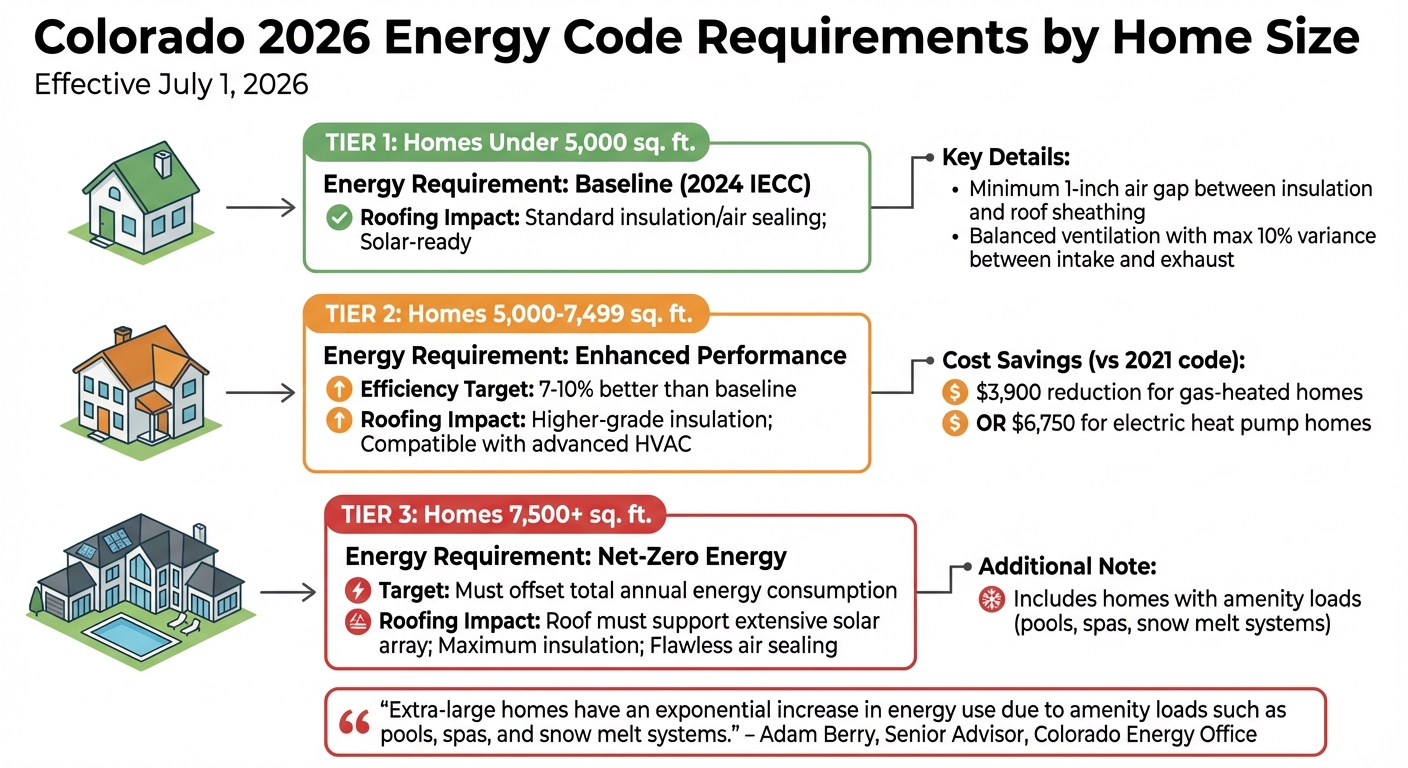
Colorado's updated energy code introduces tiered standards based on home size, aiming to balance energy efficiency with affordability. Smaller homes face less stringent requirements, while larger homes must adhere to more rigorous standards. Adam Berry, Senior Advisor at the Colorado Energy Office, explains:
Extra-large homes have an exponential increase in energy use due to amenity loads such as pools, spas, and snow melt systems.
The code divides homes into three size categories, each with unique requirements for roofing design, insulation, and solar readiness.
| Home Size (Sq. Ft.) | Energy Efficiency Requirement | Impact on Roofing |
|---|---|---|
| Under 5,000 | Baseline (2024 IECC) | Standard insulation/air sealing; Solar-ready |
| 5,000 – 7,499 | Enhanced Performance | 7-10% better efficiency than baseline |
| 7,500 and Over | Net-Zero Energy | Must offset total use with solar/renewables |
Here’s how these requirements impact roofing systems for each category.
Requirements for Homes Under 5,000 Square Feet
For homes under 5,000 square feet, the baseline 2024 IECC standards apply. Roofing systems must meet insulation depth and air sealing requirements while ensuring the structure is "solar-ready" for future solar panel installation.
Key points for roofing include maintaining a minimum 1-inch air gap between the insulation and roof sheathing and ensuring balanced ventilation. Intake and exhaust vents should have no more than a 10% variance. These standards apply to all new construction or major additions, regardless of whether your local jurisdiction has adopted them yet.
Requirements for Homes Between 5,000-7,499 Square Feet
Homes in this size range must meet enhanced performance standards, achieving 7-10% more energy efficiency than the baseline. Builders have some flexibility in meeting this requirement, which can include upgrading insulation, installing energy-efficient windows, or using high-efficiency electric heat pumps that earn energy credits.
Meeting these standards often involves using higher-grade roofing insulation and ensuring compatibility with advanced HVAC systems. Switching to these 2024 IECC standards can also reduce construction costs - by about $3,900 for gas-heated homes or up to $6,750 for those using electric heat pumps, compared to the 2021 code.
Net-Zero Requirements for Homes Over 7,500 Square Feet
Homes larger than 7,500 square feet face the most demanding requirements: achieving net-zero energy. This means generating as much energy as the home consumes annually. For roofing, this involves installing a solar array capable of offsetting total energy use or purchasing renewable energy from community solar gardens.
Larger homes require roofs designed to support extensive solar panel installations. Roofing contractors must account for load-bearing capabilities and optimize the roof layout for maximum solar exposure. Additionally, these homes need maximum insulation and flawless air sealing to minimize energy demands. If you’re planning to add 1,000 square feet or more to an existing home, these net-zero requirements may apply based on the new total square footage.
How the Energy Codes Affect Your Roof
Colorado's 2026 energy codes are shaking up the way roofs are designed, insulated, and ventilated. These changes aren't just about meeting construction standards - they address issues like moisture control, air quality, and durability, directly influencing how well your roof performs and how long it lasts.
The new rules emphasize tighter integration between your roof’s underlayment, insulation, and ventilation systems. Will Toor, Executive Director of the Colorado Energy Office, highlights the broader purpose behind these updates:
"By focusing on affordable pathways to reduce energy use and greenhouse gas pollution, this code is a smart step forward in Colorado's work to decarbonize the building sector without putting excessive burdens on developers and design teams."
Let’s break down the key updates around insulation, ventilation, and material choices that could impact your roof.
Insulation and Air Sealing Standards
The 2024 IECC standards, which form the backbone of Colorado's 2026 energy code, require more rigorous air sealing to block outdoor pollutants like wildfire smoke and ozone from entering homes. For roofs, this means creating a strong thermal barrier while ensuring proper airflow.
One critical detail: keep at least a 1-inch gap between the insulation and roof sheathing. This allows air to circulate and prevents moisture from accumulating against the wood - a common cause of condensation, mold, and early roof failure.
The code also raises insulation requirements to help homes handle extreme weather better. For low-slope roofs, often seen in modern residential designs, the minimum R-values are now R-30 in Climate Zones 4–6 and R-35 in Climate Zone 7. These higher insulation levels reduce energy use and improve comfort during Colorado's dramatic temperature swings.
Ventilation and Moisture Management
Good insulation is just one piece of the puzzle - ventilation plays an equally important role. With the industry moving away from traditional asphalt-impregnated felt to synthetic underlayments, the way moisture moves through roof assemblies is changing. Traditional felt, with perm ratings between 3.0 and 5.0, allows for some moisture transfer. However, many synthetic underlayments have perm ratings as low as 0.1, acting more like vapor barriers.
The Colorado Roofing Association cautions against making this switch without proper adjustments:
"If you remove asphalt-impregnated felt and install a low-perm synthetic felt without making corresponding system adjustments, you're changing how moisture moves through the roof assembly... and you become liable for the resulting damage."
To avoid moisture issues, roofs must maintain a minimum net free ventilating area of 1/150 of the vented space. In most of Colorado (Climate Zones 6, 7, and 8), this ratio can drop to 1/300 if a Class I or II vapor retarder is installed on the warm-in-winter side of the ceiling. When using this exception, 40% to 50% of the required venting must be located near the ridge, within 3 feet.
Balanced ventilation is key. Intake vents (at the eaves) and exhaust vents (at the ridge) should have no more than a 10% difference to meet manufacturer warranty requirements. Many shingle warranties are voided if ventilation doesn’t comply with IRC Section 806.
Additionally, ice and water shields must extend at least 24 inches beyond the warm wall of the house to protect against ice dams. This is especially crucial for Colorado homes that endure freeze-thaw cycles.
Energy-Efficient Roofing Material Options
Another big change in the 2026 code is the introduction of solar-ready requirements for all new residential construction. This means your roof must be designed to support future solar panel installation. While you’re not required to install solar panels immediately, your roof’s structure, orientation, and layout should be ready for them.
When choosing underlayment, look for high-perm synthetic materials with a perm rating above 0.50. These allow the roof assembly to "breathe", preventing condensation buildup while still meeting code standards.
If you’re replacing your roof or building a new one, document your ventilation design and material choices carefully. This not only protects your manufacturer warranties but also ensures you’re meeting code requirements. Keep in mind that Colorado is a "Home Rule" state, meaning local municipalities may adopt different versions of the IECC. Be sure to check which code your area follows before finalizing your materials.
Why Compliance Matters for Homeowners
Colorado's 2026 energy codes bring financial savings, increase home value, and support environmental goals. These updated standards provide measurable benefits that grow over time, making compliance a smart choice for homeowners.
Lower Energy Bills Over Time
On average, homeowners save $337 annually - a 19.6% reduction in energy bills. Over 30 years, that translates to $4,491 in life-cycle savings. These savings stem largely from better insulation and air sealing, which prevent heated or cooled air from escaping. This means your HVAC system doesn't have to work as hard, leading to lower energy use.
The payback period for these energy-efficient upgrades is just 4.7 years, and some homeowners start seeing positive cash flow within 0.7 years. Plus, moving from the 2021 IECC to the 2024 IECC standards can actually lower upfront construction costs by $3,900 for gas-heated homes and $6,750 for homes with electric heat pumps.
| Metric | Impact Per Home |
|---|---|
| Annual Cost Savings | $337 |
| Annual Energy Reduction | 19.6% |
| 30-Year Life-Cycle Savings | $4,491 |
| Simple Payback Period | 4.7 years |
| Positive Cash Flow | 0.7 years |
Energy-efficient homes also perform better during extreme weather. They maintain steady indoor temperatures longer, reducing the need for continuous heating or cooling during heat waves or cold snaps. These savings not only cut costs but also make your home more appealing to potential buyers.
Higher Home Value and Resale Appeal
Energy code compliance doesn't just save money - it boosts your home's market value. Features like energy efficiency and climate resilience are highly sought after by buyers who are more aware of utility costs and environmental concerns. Homes that meet the latest energy standards are seen as future-ready, making them stand out in the market.
Compliance also safeguards manufacturer warranties, especially for roofing. For instance, many shingle warranties require proper ventilation under IRC Section 806. By meeting these standards, you give future buyers peace of mind about the quality and durability of your home.
The 2026 energy code includes solar-ready requirements, which add even more value. Even if you don't install solar panels right away, having a roof designed to support them appeals to environmentally conscious buyers who may want that option later.
"A better code should feel better to live with. Expect steadier temperatures, quieter equipment, cleaner indoor air, and lower utility costs over time".
These upgrades not only improve your quality of life but also enhance your home's resale potential.
Environmental Benefits
An energy-efficient home does more than save money - it helps reduce greenhouse gas (GHG) emissions. Colorado is working toward eliminating GHG pollution by 2050. Buildings are a significant contributor, accounting for nearly 40% of total energy use in the U.S.. By complying with updated energy codes, homeowners play a direct role in supporting these decarbonization efforts.
Better insulation and air sealing also reduce strain on the electrical grid, helping utilities avoid costly upgrades to meet peak demand. Advanced systems that adjust electricity use during high-demand periods further benefit the grid and reduce overall energy consumption.
Proper ventilation and moisture management extend the lifespan of roofing materials. Additionally, preparing your roof for solar installation makes it easier to transition to renewable energy later, without expensive retrofitting.
"Strong energy codes do more than save energy; they reduce utility bills, improve comfort, improve survivability in extreme weather, strengthen grid reliability, and cut greenhouse gas (GHG) emissions".
The updated codes also improve indoor air quality, sealing out pollutants like wildfire smoke and ozone. This is particularly important as Colorado faces more frequent wildfire seasons. These measures not only create healthier living conditions but also reduce your home's environmental impact.
Getting Your Home Ready for Colorado's Energy Codes
With Colorado's updated energy codes on the horizon, preparing your home now can save you time, money, and hassle later. Here's what you need to know: if your project starts before June 30, 2026, it will follow the 2021 International Energy Conservation Code (IECC). However, any work beginning after July 1, 2026, must comply with the stricter Model Low Energy and Carbon Code.
Start with your building envelope. Focus on sealing air leaks, improving insulation, and ensuring proper ventilation in your roof. These steps not only enhance energy efficiency but also align with the new standards. Keep in mind that Colorado's "Home Rule" allows local jurisdictions to impose additional requirements, so it's critical to review the rules set by your local building department.
Plan for solar and electric readiness. Make sure your roof design is at least 40% solar-ready. Upgrading your electrical panel now can help you avoid expensive retrofits down the road. These adjustments will ensure your home is prepared for both current and future energy requirements - and local experts are here to help you navigate the process.
How Old World Roofing Can Help

When it comes to meeting these updated energy codes, having experienced professionals on your side makes all the difference. Since 1977, Old World Roofing has been a trusted name in Southern Colorado. With nearly five decades of expertise, they specialize in guiding homeowners through evolving code requirements. As an Owens Corning Platinum Preferred Contractor and a CertainTeed Master Shingle Applicator, they've also maintained an A+ rating with the Better Business Bureau since 1991.
Old World Roofing handles the technical details that make your home energy-efficient and code-compliant. This includes calculating balanced through-roof ventilation, choosing high-perm synthetic underlayments to prevent moisture buildup, and ensuring proper ventilation ratios - 1/150 of vented space, or 1/300 in Climate Zones 6–8 if vapor retarders are used. They also recommend Class 4 impact-rated shingles, ideal for Colorado's hail-prone weather, and manage all permitting and inspections.
Beyond roofing, their services extend to energy-saving upgrades like home insulation, solar attic fans, and skylights using energy-efficient Velux products. Whether you're replacing your roof, need advice on how the new codes apply to your home, or want to meet solar-ready requirements, Old World Roofing offers free inspections and estimates in Colorado Springs and Pueblo. Their team stays up-to-date on local amendments and ensures compliance with specific requirements in El Paso and Pueblo Counties, preparing your home for both today's standards and future needs.
FAQs
What should homeowners know about the 2026 updates to Colorado's energy codes?
Big changes are coming for Colorado homeowners with the 2026 Model Low Energy and Carbon Code. These updates focus on improving energy efficiency and making homes more environmentally friendly.
One major change involves stricter standards for windows, doors, and skylights. Residential windows and doors now need to meet a Li-factor of ≤ 0.30, while skylights must have a U-factor of ≤ 0.50. These measures are designed to reduce energy loss and improve insulation, which translates to better temperature control and lower utility bills.
The code also promotes the adoption of high-efficiency electric heating and water heating systems. It encourages homeowners to embrace electrification and include demand-response technology, which helps manage energy use more effectively. Additionally, enhanced air sealing and ventilation requirements aim to boost indoor comfort while cutting down on energy waste.
Although on-site renewable energy systems, like solar panels, are no longer required, they’re still recommended as a way to lower energy costs and reduce carbon footprints. These updates reflect Colorado's commitment to helping homeowners save money and contribute to a cleaner, more energy-conscious future.
How do Colorado’s new energy codes affect my home’s cost and value?
Colorado’s new energy codes are designed to make homes more energy-efficient, and the benefits extend well beyond just cutting utility bills. On average, these updates could save homeowners about $337 per year on energy costs, translating to an impressive 20% reduction. Over three decades, that means potential savings of around $4,500.
But it’s not just about the money. These codes also improve your home’s overall performance. Think better moisture control, improved airflow, enhanced durability, and a noticeable boost in indoor comfort. Plus, homes built or upgraded to meet these energy standards often attract higher resale values, thanks to their energy-saving features and the long-term financial perks they offer.
How can I make sure my home meets Colorado's 2026 energy codes?
To make sure your home aligns with Colorado’s 2026 energy codes, start by checking if your local area has adopted the state-required Model Low Energy and Carbon Code, which takes effect on July 1, 2026, along with the 2021 International Energy Conservation Code (IECC). Once confirmed, reach out to a qualified contractor to evaluate your home’s insulation, air sealing, and windows. Pay particular attention to your windows - ensure they meet the updated ENERGY STAR standards, such as a U-factor of ≤ 0.22 and SHGC ≥ 0.17.
You’ll also want to upgrade your heating and water-heating systems to high-efficiency electric models. Additionally, check that your home complies with the new Electric-Ready and Solar-Ready guidelines. These upgrades not only help you stay compliant but also enhance energy efficiency and could lower your long-term energy bills. For reliable advice and assistance, consider partnering with a contractor like Old World Roofing.